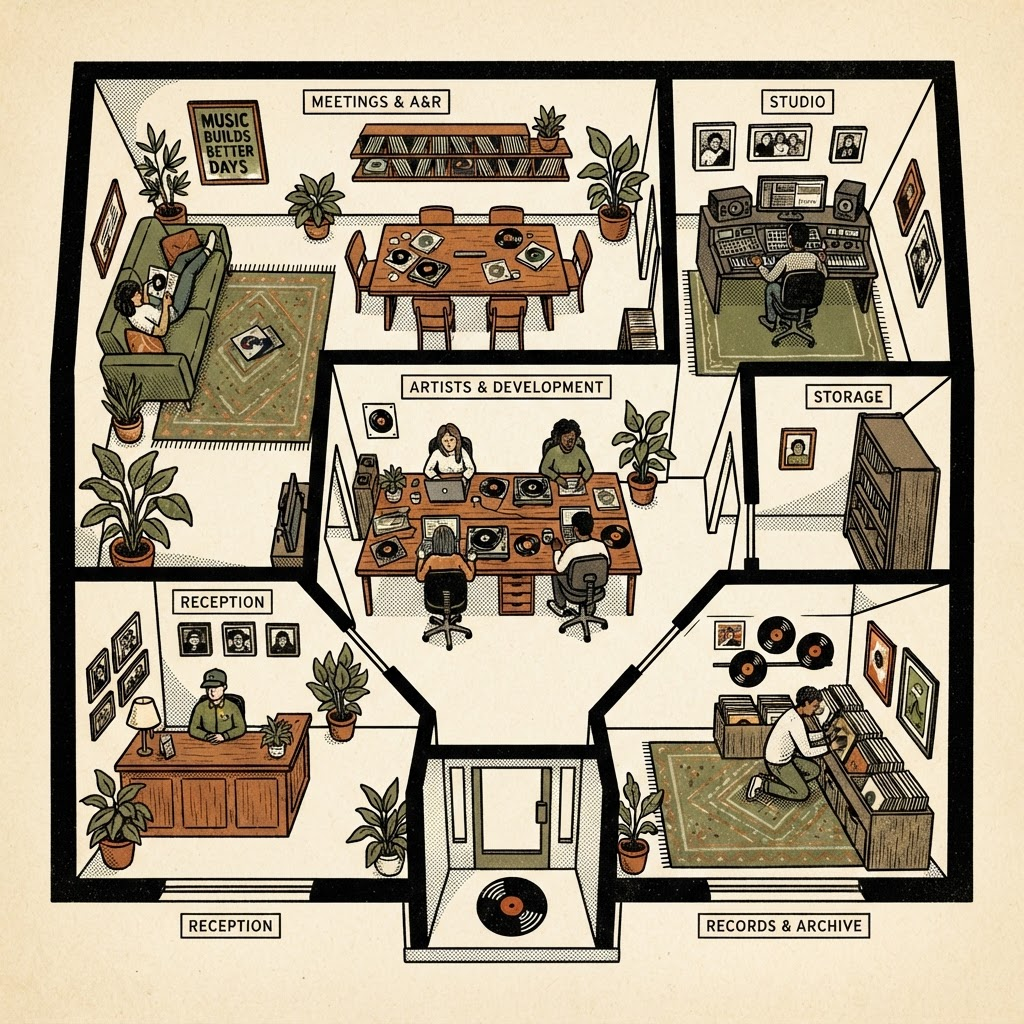
An independent music career is run in a dozen places at once. Second Verse puts all of it in one place for artists and the teams around them — and carries the music out to the platforms itself, so the numbers that decide the next move come back first-hand rather than second-hand and months late.
Distribution
The way in, not a feature alongside one. Rights-neutral and term-limited, with no claim on your masters, and included at every tier. A distributor is the party the platforms report to, which is how the streams and the money come back first-hand instead of through somebody else’s statement months later.
The operating layer
Every department an artist would otherwise need a label for, as rooms in one office: the strategy, the songs, the release, the content, the gigs, the rights, the money and the people who help with each. The office grows as desks are hired, so a phone and a fifty-release roster walk through the same building.
The network
The people beyond the office — artists, producers and managers in other cities and countries. It opens a corridor at a time, where there are enough people at the far end who will answer an ask, rather than on a count of accounts. A network that cannot receive anyone is worse than no network at all.
The office
A label’s departments, as rooms you can walk into
20 desks in 5 rooms, plus the building around them, and every release that goes out goes out of these rooms. Every room and every desk is named what the industry calls it — the same to an artist, a manager and a label. Open a desk and you get its record, what it has been doing, what it needs from you, and a conversation with whoever works there.
The office, from above — every room named what the industry calls it.
A&R
Where an artist is met, and everything that has to be right before a release can go anywhere.
Signing4
Rights + Label Copy9
Scouting2
Marketing
The plan, the identity, the channels, the press and the radio — and the numbers that say whether any of it worked.
Strategy + Brand14
Digital13
Creative12
Press4
Radio2
Insights17
Distribution + Licensing
Every door the music goes out through: to the platforms, direct to the fan, and to screens and brands.
Platforms9
Direct to Fan10
Sync + Brands2
Finance
Every other desk earns; this one counts.
Finance10
Live
Gigs, touring, the rooms already played, and the merch a room actually sells.
Live10
The building
Not rooms: the home screen you open onto, the network beyond the office, the corridor between the departments, the inbox behind a bubble, and everything that is not a desk.
Today10
Network4
Coordination9
Inbox + AI5
Roster3
Account14
The figure beside each desk is how many features it carries.
How the office grows
A subscription grants a room whole — there are no depth gates inside something you already have. There is no locked door and no price on a wall either: until a desk is hired, the office simply does not have that room.
Self Serve
9 desks
One artist, the core rooms, and delivery to every platform.
Roster
18 desks
Managers and micro-labels running several artists, and solo artists who want the whole engine.
Label
20 desks
The independent label: staff with job titles, and the two rooms only a roster owner has.
Prices are set with the first pilots and are not published here until they are settled.
Who it’s for
One record, seen from every side
The same data, seen through whichever lens the person holds — never four products. An artist films and approves; a manager plans and chases; a label reads a roster; a specialist gets one desk and nothing around it.
Every desk has someone behind it — and a conversation you can open.
Artists
The person the account exists for. Knowing what to do next, and not falling behind — on a phone, one card at a time.
Management
One person or a small team running two to eight artists. Capacity: the next artist without the next working week.
Labels
Two to fifty artists and staff with job titles. Coordination across a roster, and evidence of return on spend.
Specialists
A photographer, a co-writer, a publicist, a plugger, a booking agent. One desk, for one artist, for a term — and nothing around it.
Principles
Two promises, and a list of things we will not build
Nothing in your name without you
Every post is approved by the artist before it goes anywhere — a recorded event, on a phone, in seconds. A manager can draft, schedule and chase. They cannot publish over you.
No number shown with more confidence than it deserves
Every figure carries a label: measured, imported, estimated, or not enough data. A pattern is not called a finding until there is enough of it to be one. The tool will say it does not know yet rather than invent one.
What we will never do
Asked for, and declined. The list is published so it can be held against us, and it is enforced in the code rather than in a policy document.
Guaranteed metric claims. Nobody can promise a listener.
Auto-publishing anything without the artist’s approval step.
Showing an investor, a parent company or an affiliate what is inside a tenant’s record.
Joining a fan across two artists. A fan who follows three artists here is three records.
Posting-time science on channels that publish no timing data.
And your work leaves with you. Everything an artist puts in can be taken out, quickly, and nothing here depends on making leaving difficult.
Get in touch
Early access opens with the first pilots
If you are an artist, a manager or a label and this reads like the job you are already doing by hand, we would like to hear from you — and we would rather hear what is wrong with it than what is right.